
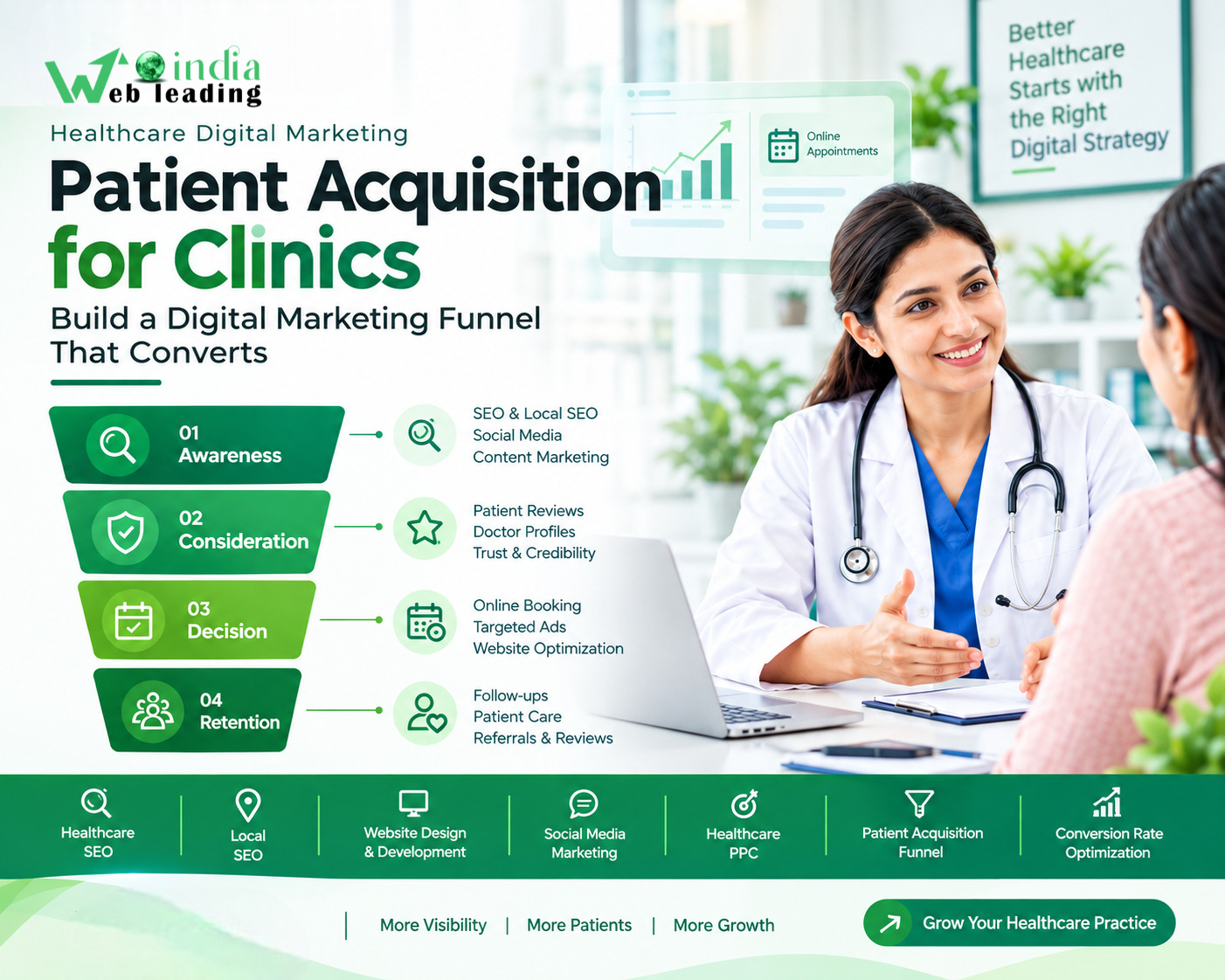
Patient Acquisition for Clinics: How to Build a Digital Marketing Funnel That Converts
Most clinics don't have a patient problem—they have a funnel problem.
You're running ads. You're posting on social media. Your website looks professional. But appointments aren't filling up the way they should. The issue isn't visibility. It's that there's no system connecting awareness to trust to conversion. Patients slip through the cracks silently, and you never see where it happened.
This guide breaks down exactly how to build a patient acquisition funnel that actually converts — one stage at a time.
Why Most Clinic Marketing Fails (And It's Not What You Think)
Here's the uncomfortable truth: a patient might see your Instagram reel today, read your Google reviews next week, visit your website after a month, and book an appointment three months later. If you're judging marketing success after 30 days, you're setting yourself up for disappointment.
Most clinics treat digital marketing like a vending machine — insert ad spend, receive patients. But healthcare decisions don't work that way. Unlike retail, patients aren't impulse buyers. They need clarity, trust, and reassurance before they commit.
The real problem isn't a lack of ads. It's the absence of a system that connects awareness, trust, and conversion into one measurable engine.
The Patient Decision Journey: What Actually Happens Before Someone Books
Before designing your funnel, you need to understand how patients actually choose a provider.
Path A: A patient searches for local care options, filters by location, services, and reputation, then picks the best match.
Path B: A patient recalls a provider they've heard of, searches to confirm they're a good fit, then books.
Both paths share one critical thread: patients want reassurance before they commit. Research shows people typically consider only two to three practices before calling one. The window to capture their attention is narrow, and the moment of hesitation is where most clinics lose them.
Stage 1: Top of Funnel — Awareness (Making People Know You Exist)
Goal: Be findable when patients first recognize they have a problem.
At this stage, patients know something is wrong. They don't know you exist yet. Your job is to show up where they're looking.
What works at this stage:
SEO-optimized blog content answering symptom-based questions ("Why do my knees hurt when climbing stairs?")
Educational social media reels and health awareness campaigns
Google Business Profile optimization — this is the dominant review platform for local healthcare, and it drives more qualified phone leads than any other organic channel
Video content introducing your doctors and explaining conditions in plain language
What to measure: Clicks, content engagement, and reach — not conversions.
Common mistake: Putting your entire budget here. Hospitals typically pour 80% of their marketing spend into awareness, then wonder why conversions stay flat.
Stage 2: Middle of Funnel — Consideration (Building Trust Before the Patient Is Ready to Book)
Goal: Help patients feel confident choosing you over the clinic down the street.
This is the longest, most psychologically loaded stage — and the one most clinics neglect. The patient has a shortlist. They're reading reviews, comparing credentials, watching procedure videos late at night. They're not ready to call. They're gathering evidence that you're the right choice.
What works at this stage:
Google reviews and patient testimonials (with proper consent)
Detailed doctor profiles with real credentials, not generic "world-class care" language
FAQ pages addressing unspoken fears — insurance coverage, pain, recovery time
Success stories and outcome data that speak to real patient results
Consistent follow-up through WhatsApp or email for patients who've shown interest
What to measure: Multi-page visits, video watch time, downloads of resource guides, review engagement.
The trust architecture insight: This stage is where bookings are won or lost. If you're invisible here — if there's no proof, no safety, no relatability — you're eliminated here.
Stage 3: Bottom of Funnel — Decision (Removing Every Friction Point)
Goal: Turn interest into a booked appointment with zero obstacles.
The patient has decided they want to move forward. Now every friction point is an opportunity for them to abandon.
What works at this stage:
High-intent Google Search Ads for keywords like "dermatologist near me" or "orthopedic surgeon [city]"
Online self-scheduling — if booking requires a phone call during business hours, you're losing patients
Transparent pricing for common procedures (where appropriate)
Fast response times — patients expect a response within 24 hours; 79% expect it faster
Simple call-to-action — one clear next step, not five competing buttons
What to measure: Appointment bookings and cost per acquisition.
Mobile reality check: Mobile traffic accounts for roughly 83% of healthcare website visits, but mobile bounce rates run 10 percentage points higher than desktop. Every 100 milliseconds of load time costs about 1% in conversions. A page that takes 4 seconds instead of 2 has already lost roughly 20% of potential conversions before the patient reads a word.
Stage 4: After the Booking — Retention and Advocacy (Your Cheapest Acquisition Channel)
Goal: Turn one-time patients into repeat patients and referral sources.
Marketing doesn't stop when the appointment is booked. The patient experience either validates or contradicts every promise your marketing made.
What works at this stage:
Automated appointment reminders via SMS and WhatsApp — SMS recall confirmation rates hit 65%, meaning nearly two-thirds of lapsed patients rebook with a well-timed message
Post-visit follow-ups checking on recovery and satisfaction
Review generation — asking satisfied patients to share their experience while it's fresh
Referral programs that make it easy for happy patients to send friends and family
The retention math: The average patient retention rate is 78%. Top-performing practices hit 88% or higher. Closing that gap represents real revenue — and it's dramatically cheaper than acquiring new patients.
The Metrics That Actually Matter (Hint: Not Cost Per Lead)
Cost per lead is the most over-reported and least useful number in healthcare marketing. A lead isn't a patient. Two practices with identical CPLs can have wildly different real acquisition costs.
Track these instead:
For specialty practices, benchmarks show that a $70 cost per lead can translate to a true patient acquisition cost of $225 to $870 depending on booking and close rates. That 5–15× multiplier is why lead volume alone is a dangerous metric to optimize for.
Building Your Clinic's Funnel: A Practical Starting Point
Step 1: Map your current patient journey. Where do patients first discover you? What do they read before booking? How long does the process take?
Step 2: Measure conversions at each stage. You can't optimize what you don't measure.
Step 3: Find the bottleneck. Is it awareness (not enough people finding you)? Consideration (people finding you but choosing competitors)? Decision (people wanting to book but hitting friction)? Retention (patients not coming back)?
Step 4: Fix one thing at a time. The clinics that grow aren't the ones doing everything. They're the ones diagnosing their specific weakness and addressing it directly.
The Bottom Line
A patient acquisition funnel isn't a set of tactics. It's a system that moves people from "I have a problem" to "I'm booked" to "I'm telling my friends about you" — without gaps where they can slip away.
Marketing doesn't fail because of a lack of ads. It fails because there's no architecture connecting awareness, trust, and conversion.
Build the funnel. Measure each stage. Fix the leaks. The appointments will follow.