
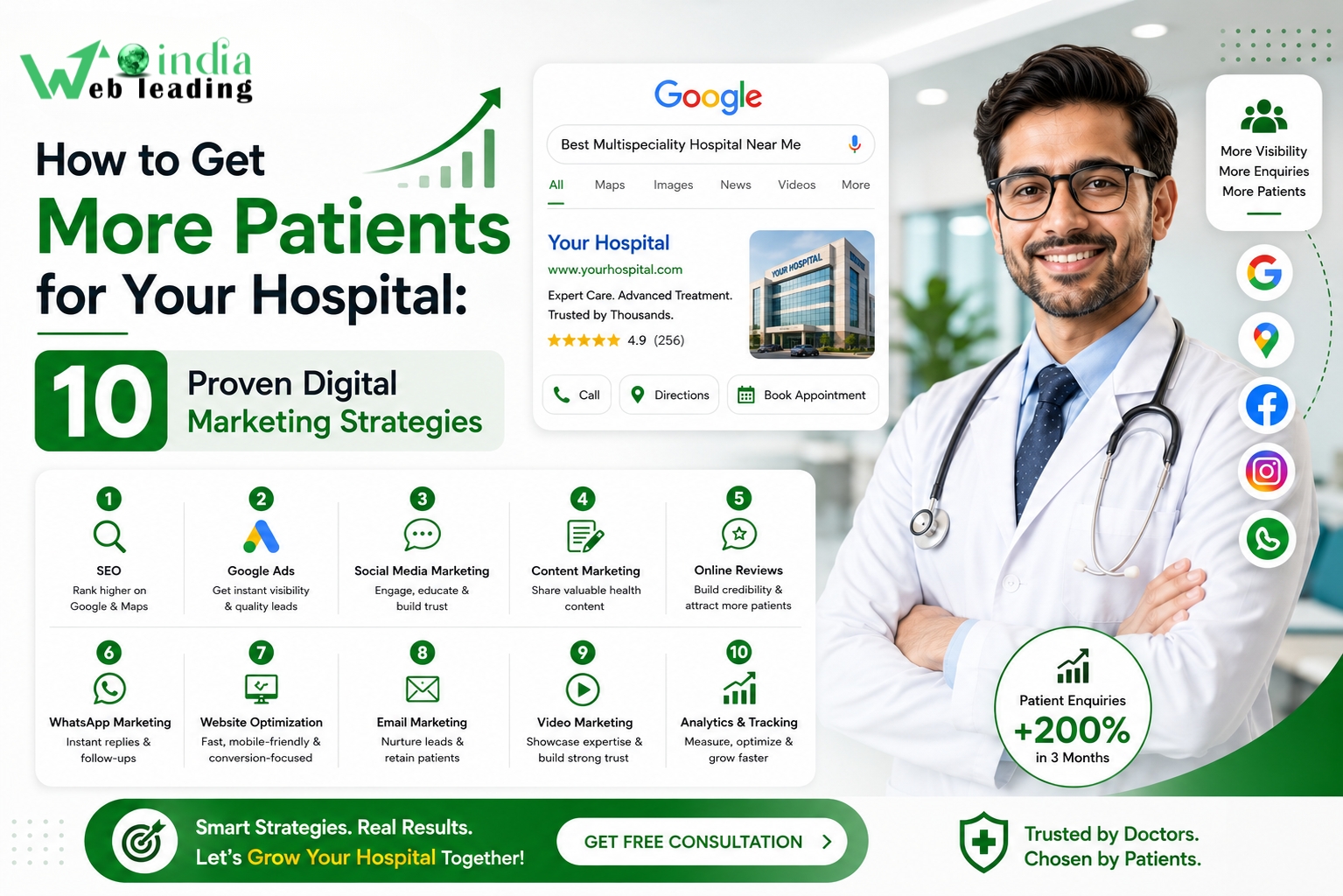
How to Get More Patients for Your Hospital: 10 Proven Digital Marketing Strategies
In today's digital-first world, the journey to your hospital often begins with a simple online search. Patients are no longer just relying on referrals or proximity; they are actively researching doctors, comparing facilities, reading reviews, and evaluating the quality of care on their smartphones before they ever step into a clinic . For hospitals and healthcare providers, this shift in behavior isn't just a trend—it's the new reality. To thrive and grow, you need a robust digital marketing strategy designed to attract and convert these informed patients.
At Web Leading India, we specialize in helping healthcare providers like you navigate this complex landscape. As the premier healthcare digital marketing agency in India, we understand the unique challenges and opportunities in the medical field . Our patient-focused strategies are designed to connect you with the right patients at the right time, ensuring sustainable growth for your practice. Here are 10 proven digital marketing strategies to help you get more patients for your hospital.
1. Build a Patient-Centric, High-Converting Website
Your hospital's website is often the first impression you make on a potential patient. It needs to do more than just list your services; it must build trust and facilitate action. A modern, patient-centric website prioritizes ease of use and addresses the top tasks patients want to accomplish.
What to Include:
Easy-to-Use Appointment Booking: Online scheduling is a standard expectation. Allow patients to book appointments at their preferred time without needing to make a phone call .
Straightforward Navigation: Patients should easily find treatment options, doctor profiles, and contact information. Clear, intuitive design is key.
Detailed Doctor Profiles: Include high-quality photos, specialties, experience, and credentials. Patients connect with people, not just institutions .
Accessibility Features: Ensure your website is ADA and W3C compliant to be accessible for all users, including those with disabilities. This includes mobile optimization, proper contrast ratios, and alternative text for images .
Patient Portal & Online Forms: Provide a secure way for patients to pay bills, fill out pre-visit forms, and access their health information .
Internal Link Opportunity: Learn more about our Medical Website Development and Healthcare Web Design services.
2. Optimize for Local SEO & Google Maps Visibility
When patients need care, they often search for hospitals "near me" or "best cardiologist in [city]." If your hospital doesn't appear in these local search results, you're invisible to a massive pool of potential patients. Local SEO is the cornerstone of patient acquisition.
How to Dominate Local Search:
Optimize Your Google Business Profile: Ensure your profile is 100% complete with accurate NAP (Name, Address, Phone number), operating hours, services, categories, and high-quality images. A complete profile is the single highest-leverage fix for most hospitals .
Use Location-Based Keywords: Integrate local keywords naturally into your website content, such as "pediatric hospital in Mumbai" or "knee replacement hospital in Delhi" .
Build Consistent Citations: Ensure your hospital's name, address, and phone number are consistent across all online directories and citation sites.
Manage Online Reviews: Actively encourage satisfied patients to leave positive reviews on Google and other healthcare platforms. A hospital with a 4.5+ star rating will consistently outrank competitors with lower ratings . Respond to every review, positive or negative, professionally and within 48 hours.
Internal Link Opportunity: Explore our Healthcare SEO Services to improve your local rankings.
3. Run Targeted Paid Advertising (PPC)
While SEO builds long-term, sustainable traffic, paid advertising (like Google Ads and Meta Ads) provides an immediate boost to patient volume. It's a powerful way to capture high-intent searches and promote specific services or health checkup packages.
Key PPC Strategies:
Service-Specific Campaigns: Create targeted campaigns for high-value procedures like "knee replacement in Bangalore" or "IVF specialist near me." These high-intent keywords convert faster than generic brand campaigns .
Retargeting Campaigns: Re-engage website visitors who didn't book an appointment with ads promoting doctor availability or special offers.
Use Custom Audiences: Target specific demographics or people with certain health interests using social media platforms like Facebook and Instagram.
Track Cost-Per-Appointment: Focus on the cost of acquiring a patient, not just the cost-per-click. A cardiac bypass lead is worth more than a general OPD lead, and your budget should reflect that .
Internal Link Opportunity: Discover our Healthcare Digital Marketing and SMO Services for expert campaign management.
4. Educate Patients with Health-Focused Content Marketing
Content marketing is about building trust and establishing your hospital as an authority. By creating valuable, educational content, you answer patient questions before they even ask, positioning your hospital as the go-to source for reliable health information.
Effective Content Ideas:
Blog Posts: Write articles explaining common treatments, procedures, and preventive care tips.
Doctor Q&A Videos: Feature your doctors answering common patient FAQs. This humanizes your brand and builds confidence.
Patient Success Stories: Share de-identified testimonials and case studies that highlight positive patient experiences and outcomes .
Infographics: Present health statistics and preventive care information in a visually engaging way.
Internal Link Opportunity: Our team can help you craft a winning Healthcare Content Strategy.
5. Implement AI-Driven Patient Engagement Tools
AI is revolutionizing healthcare marketing by personalizing the patient journey and improving efficiency. AI tools ensure no lead falls through the cracks and that patients receive timely, relevant communication.
AI in Action:
Chatbots for Patient Pre-Screening: AI-powered chatbots can handle initial inquiries, answer FAQs, and even schedule appointments instantly .
Automated Outreach: Use automation to send appointment reminders, follow-up messages, and health tips to nurture leads and reduce no-shows .
Predictive Analytics: Analyze patient data to identify those at risk of churn or those due for preventive screenings, allowing for proactive outreach .
6. Manage Your Online Reputation
In healthcare, trust is paramount. Your online reputation is the digital currency that can make or break a patient's decision to choose your hospital. A proactive approach to reputation management is essential.
Reputation Management Best Practices:
Monitor All Review Platforms: Actively track reviews on Google, Healthgrades, Practo, and social media .
Respond to All Feedback: Respond to both positive and negative reviews promptly, professionally, and empathetically.
Showcase Testimonials: Highlight positive reviews and testimonials on your website and social media channels .
Address Negative Feedback Proactively: If a patient has a poor experience, address it directly to resolve the issue. This can turn a detractor into a promoter.
7. Build Trust Through Social Media Engagement
Social media is a powerful tool to humanize your hospital brand and build a community. It allows you to interact with patients in a more personal and engaging way, showing the people and stories behind the institution.
Social Media Strategies:
Humanize Your Brand: Share doctor introductions, behind-the-scenes tours, and celebrate staff achievements.
Share Patient Success Stories: With patient consent, share their journeys to inspire others and showcase your care quality.
Live Q&A Sessions: Host live sessions on health awareness days or common health topics with your specialists.
Showcase Community Involvement: Highlight your hospital's participation in health camps or community events.
Internal Link Opportunity: Boost your social presence with our Healthcare Brand Management services.
8. Promote Your Doctors and Medical Team
Patients often choose a hospital based on the reputation of a specific doctor. Promoting your medical team as individual experts builds a personal connection and drives patient bookings.
How to Promote Your Team:
Doctor-Specific Landing Pages: Create dedicated pages for each doctor with high-quality videos, detailed credentials, and a clear call-to-action to book an appointment .
Specialist Interview Videos: Feature doctors answering patient FAQs and discussing their specialties.
Personal Branding: Encourage your doctors to maintain a professional and authentic online presence on platforms like LinkedIn .
9. Engage Existing Patients with Email Marketing
Acquiring a new patient can cost significantly more than retaining an existing one . Email marketing is a cost-effective way to nurture relationships with your current patient base, encourage repeat visits, and build loyalty.
Effective Email Campaigns:
Appointment Reminders & Follow-ups: Send automated reminders for upcoming appointments and follow-ups for screenings or annual checkups .
Health Tips & Blog Updates: Share valuable health information to keep your hospital top-of-mind.
Exclusive Offers: Promote health checkup packages or new services to your existing patient list.
Patient Feedback Surveys: Send surveys to gather feedback and improve the patient experience.
10. Measure What Matters and Optimize Continuously
You can't improve what you don't measure. To ensure your marketing budget is delivering a strong return on investment (ROI), you need to track the right metrics and continuously optimize your campaigns.
Key Metrics to Track:
Patient Acquisition Cost (PAC): The total cost to convert a prospective patient into a paying one. If your PAC exceeds the patient's lifetime value, you're losing money .
Conversion Rates: Track how many website visitors actually book an appointment.
Traffic & Lead Sources: Understand where your best patients are coming from (e.g., organic search, paid ads, social media) .
Appointment No-Show Rates: Identify patterns to reduce cancellations and maximize your schedule.
Campaign Performance: Regularly review KPIs and conduct A/B testing on landing pages and CTAs to find what resonates best .
Internal Link Opportunity: Our Healthcare Digital Marketing approach is built on continuous optimization for maximum ROI.
Conclusion
Attracting more patients in 2026 requires a holistic, data-driven digital marketing strategy. By building a patient-centric website, optimizing for local search, engaging through content and social media, and leveraging the power of AI, you can build a sustainable pipeline of new patients.
Ready to Transform Your Healthcare Digital Presence?
At Web Leading India, we have a proven track record of helping 200+ healthcare clients grow their patient base through specialized digital solutions. As India's premier healthcare marketing agency, we understand the nuances of medical marketing and can create a custom plan tailored to your unique needs . Let us help you build a powerful online presence that attracts more patients and grows your medical practice.
Frequently Asked Questions (FAQ)
1. What is the most important digital marketing strategy for a hospital?
While all strategies are interconnected, building a high-converting, patient-centric website and optimizing for local SEO are the most critical foundational steps. These ensure that when patients search for your services, they can find you and easily take action.
2. How can I measure the success of my hospital's digital marketing?
Success is measured by tracking key performance indicators (KPIs) such as Patient Acquisition Cost (PAC), conversion rates, appointment bookings, website traffic from organic search, and the number of leads generated from campaigns like PPC.
3. What is Local SEO for hospitals and why is it important?
Local SEO is the process of optimizing your online presence to rank higher in location-based searches (e.g., "hospital in Delhi"). It is crucial because most patients search for healthcare services near them. Optimizing your Google Business Profile and managing reviews are key components .
4. Is it worth it for hospitals to invest in paid advertising?
Yes. While SEO is a long-term strategy, paid advertising (Google Ads, Social Media Ads) provides immediate visibility and is highly effective for promoting specific services or reaching a targeted audience quickly. It helps capture high-intent patients searching for specific procedures .
5. How important are online reviews for a hospital?
Extremely important. Online reviews are a major trust signal. A significant majority (84%) of patients check online reviews before choosing a provider . Actively managing and encouraging positive reviews is essential for attracting new patients.